
Fans of comedian and performance artist Nathan Fielder might find themselves better equipped for what to expect from his documentary on Elizabeth Holmes, You Can See Everything.
Having witnessed Fielder’s ability to turn a standard interview on his show Nathan for You into moments like a man joking about drinking his grandson’s urine or transforming a Houdini-inspired handcuff trick into escaping registration as a sex offender, viewers might have slightly altered expectations this time around.
Nevertheless, it remains challenging to prepare even the most devoted fans of the show for what lies ahead, as Fielder embeds himself with Holmes and her partner, Billy Evans, during the weeks leading up to her imprisonment for defrauding investors with her malfunctioning blood testing technology.
It’s not just the typical discomfort Fielder creates that makes this documentary unique; it’s also the prolonged stares he shares with the earnest, doe-eyed founder of Theranos as he attempts to uncover her motivations behind her actions.
While it’s possible to summarize the documentary’s overarching themes, one might say that You Can See Everything endeavors to expose every facet of a person’s life, all while illustrating the inherent strangeness and complexity of even the most basic truths about individuals. The film’s captivating cinematography and bizarre situations come together to present a documentary that feels more cohesive than your average drama.
Yet, paradoxically, the film’s truly unique originality undermines the very concept of documentary storytelling. Instead of clarifying who Holmes is, Fielder demonstrates that increased visibility—particularly when dealing with perplexing human beings—often leads to greater ambiguity.
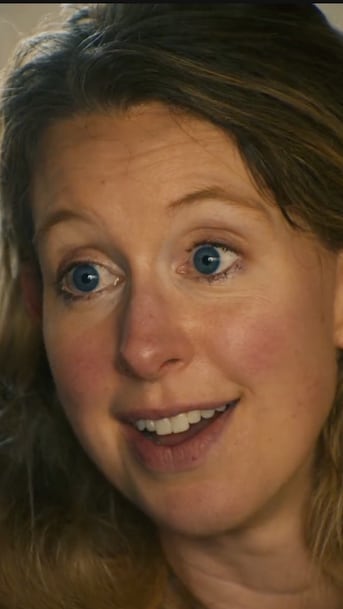
Nathan Fielder’s You Can See Everything gazes into the abyss of Elizabeth Holmes. The documentary about the jailed Theranos founder examines the absurd nature of truth.
However, the most challenging aspects to navigate are the specifics; the eagerly awaited surprises that disrupt viewers’ conventional ideas about how documentaries should function, rather than providing substantial new insights about the woman currently serving time.
As critics were cautioned through a personal video from Fielder and co-director Lance Oppenheim, the unsettling and revealing nature of You Can See Everything lies in its unpredictability. As a viewer, one might expect a straightforward talking-head documentary focusing on corporate wrongdoing, only to be taken aback by unexpected nudity, AI representations, and the sudden appearance of a celebrity.
Watching You Can See Everything does not unveil shocking new details regarding the potentially dubious dealings that accompanied Holmes’ establishment of Theranos, the healthcare firm that claimed to create a device capable of running numerous tests from a single drop of blood.
Through various depositions, court hearings, and the Emmy-winning series The Dropout, the public has been captivated by Elizabeth Holmes.
Most have concluded that she resembles another aspiring Steve Jobs. However, unlike him, she was willing to misrepresent her product’s capabilities in the hopes that it would eventually function and generate profit.

Nathan Fielder arrives at the 77th Primetime Emmy Awards on Sunday, Sept. 14, 2025, at the Peacock Theater in Los Angeles. (Jae C. Hong/The Associated Press)
As Holmes, along with her fiancé Evans, shares, this is precisely why Fielder is present.
They contend that the issue lies in the public’s misunderstanding of the true Elizabeth Holmes, shaped by a barrage of misleading headlines and misconstrued information that paints a picture far removed from reality.
They believe that if Fielder could uncover her genuine self, they could resume their endeavors, which, as it turns out, involves launching Theranos 2.0 (this time, inexplicably, with lasers).
Fielder’s forewarning proves insightful: What happens if he uncovers something Holmes wishes to keep hidden? In a moment reminiscent of Pinocchio, her response is equally troubling—she claims to have nothing to conceal.
As Fielder delves deeper into Holmes and Evans’ eccentric domestic life, he uncovers a series of startling revelations and an almost comically sinister surprise antagonist.
We observe Fielder probing into their peculiar household habits (reportedly, they prefer their beds without mattresses and hold peculiar views on egg-beating techniques). Additionally, he tests the complexities of Holmes’ psyche, notably through a segment that painstakingly unravels an Abbott and Costello routine.
More intriguing than the enigmatic depths of Holmes’ mind is Fielder’s own. Similar to his other projects that challenge the boundaries of “reality” entertainment, You Can See Everything heavily depends on Fielder’s struggles to comprehend, interpret, and document reality.
As he seeks an elusive absolute truth, the camera frequently turns back to him, capturing him in a Spielbergian silhouette, employing increasingly convoluted strategies to gain access to his subject who now resides behind bars, or—in an almost absurd twist—questioning the very impulse to create a documentary.
-
Audio
Weekly Wrap: Primetime and The History of Concrete
-
Director Alex Gibney on terrifying Musk documentary: ‘It’s not a funeral; it’s a warning’
It remains cryptic. However, without revealing too much, it is evident that as Fielder employs increasingly absurd and artificial methods, the focus shifts more toward him rather than Holmes. Similar to the recent documentary sensation The History of Concrete (where Fielder also makes an unexpected appearance), the intended subject of the documentary becomes less significant as the story unfolds.
Ultimately, it transforms into a commentary on the art of documentary filmmaking itself. Yet, while The History of Concrete critiques the dismal state of the documentary industry—such as securing funding, crafting pitches, and narrating tales that remain unclear until completion—You Can See Everything questions its own objectives.
What constitutes objectivity, and when does defending the truth overlap with advocating for a subject’s personal interpretation of their own truth? What drives the desire to attain a conclusive, fully realized truth about someone—and is the feeling of achieving this at the conclusion of documentaries misguided or potentially harmful? What distinguishes fiction from “reality” entertainment, and how far can one push the boundaries before they blur into one another?
These are questions Fielder appears to explore as he navigates in and out of Holmes’ life, creating a documentary so stylized and direct that it scarcely resembles a traditional documentary.
Ultimately, it morphs into something more alien and peculiar: a form analyzed and scrutinized to the point of becoming unfamiliar. Concerning both Fielder’s subject and his approach, it feels like the closest approximation of truth we may ever encounter.

