
For ages, humanity has aspired to venture into and discover the mysteries of space. Frequently, science fiction depicts settlements on the barren surfaces of the Moon and Mars.
Listening to billionaires such as Elon Musk and Jeff Bezos suggests that lunar cities are on the horizon.
In fact, earlier this year, SpaceX CEO Musk shared on social media that the company’s ambitions have shifted from Mars colonization — a passion of his for the last ten years.
“For those who may not be aware, SpaceX is now concentrating on creating a self-sustaining city on the Moon, which we could potentially accomplish in under ten years, unlike Mars, which would require over 20 years,” he stated.
This announcement — alongside claims from Blue Origin CEO Bezos, who has stated that “millions of people” will inhabit space by 2045 — piqued the interest of Martin Elvis, a senior astrophysicist at Harvard University’s Smithsonian Astrophysical Observatory.
Along with astrophysicist Jonathan McDowell from the Durham University Space Research Centre in England, he examined the data.
Their results, however, are not promising for a lunar settlement, so don’t start packing your bags just yet.
In their publication, released in the journal Frontiers in Space Technologies, the researchers focused on the energy and water requirements for supporting human life on the Moon.
Regarding energy, they concluded that solar and nuclear power could indeed sustain one million residents on the Moon.
However, the challenge arises with water.
It may surprise some, but there is indeed water on the Moon, believed to be largely trapped in permanently shadowed regions (PSR) at the lunar poles that never receive sunlight.
Yet, their study revealed that there is insufficient water on the Moon to support a substantial human population.
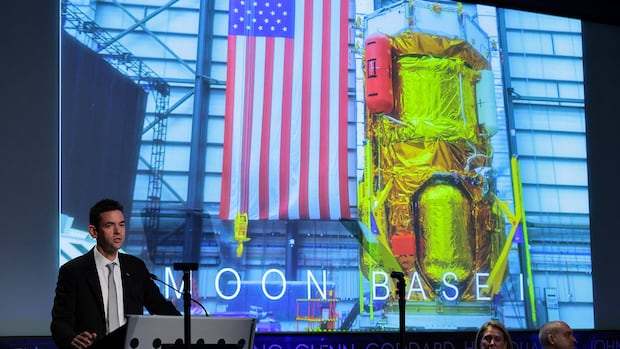
NASA has outlined its plans to build a base on the moon that will first be occupied by rovers and drones, but the longer-term goal is human habitation.
“Our research indicates that establishing an Antarctic-style base on the Moon for several centuries is feasible. A small town could also be viable. However, if the goal is to develop extensive cities across the Moon, similar to the most imaginative science fiction, we must find a way to transport water there, as it’s currently not available,” McDowell remarked.
Assuming there are around one billion tonnes of water on the Moon, which aligns with current projections, they discovered that a population of one million could only survive on the lunar surface for approximately 100 years. This is contingent on achieving a water recycling rate of 98 percent, akin to practices on the International Space Station.
‘A small lake’
Elvis noted that while one billion tonnes of water seems substantial, it’s essential to put it into perspective.
“If one envisioned an enormous aquarium the size of Central Park in Manhattan, filled to a level just beneath the Statue of Liberty, that’s the volume of water available. It’s considerable in one sense, yet… it’s merely a small lake. And a small lake cannot support a large city for an extended period,” he explained.
Nevertheless, this does not imply that human habitation on the Moon is impossible. Their findings suggest that a community of 10,000 could sustain itself for centuries.
However, this is predicated on the assumption that the estimate of one billion tonnes of water is accurate.
“It’s highly probable that a billion is an overestimate. It might actually be 20 to 30 times excessive,” Elvis stated.
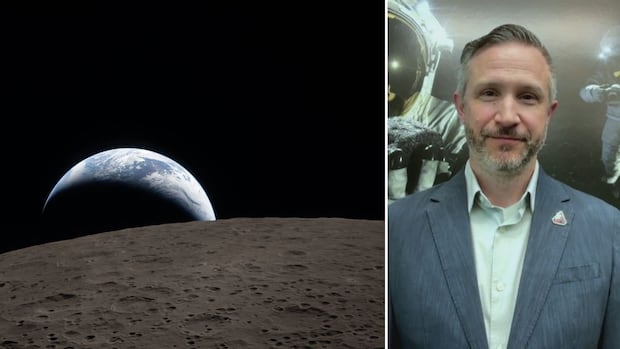
Jacob Bleacher, NASA’s chief exploration scientist, says the first two Artemis missions have set the stage for the next moon landing, a moon base and eventually, human exploration of Mars, missions so challenging that only international co-operation makes them possible.
He added that it’s improbable we would fully recover the available water. More realistically, it would be closer to one-third to one-half of what is present.
“My best estimate is that the actual amount of recoverable water is just one percent of earlier estimates. Thus, instead of a hundred years, we might only have one year,” he suggested.
Additionally, there remains uncertainty regarding the form in which that water exists, which needs to be clarified.
-
We’ve already been to the moon, so why are we going again?
-
NASA has set its sights on a moon base. Here’s how Canada can play an important role
“While it’s one thing to detect water from satellites, there are uncertainties in those assessments,” stated Gordon Osinski, a professor of planetary geology at Western University in London, Ontario.
“I believe it exists, but we need to conduct ground verification to confirm it. Moreover, there are larger unknowns regarding its form… Is it similar to permafrost found in the Arctic, which consists of soil and tiny ice crystals that are challenging to extract?”
Although this may seem like discouraging news for humanity’s ambitions to explore the universe, McDowell emphasized the importance of understanding the reality.
“The truth is never negative,” he affirmed. “What is truly negative is attempting something that may not succeed.”

