
The most effective remedy for struggling coral might be the simple act of touch.
Researchers from Stanford University in California made an intriguing discovery when two coral pieces in a laboratory — one that was bleached and another that was healthy — accidentally made contact while toppling in a tank.
“We observed the healthy coral transferring vibrant beneficial algae to the bleached corals, and we saw its color rejuvenate right before our eyes,” stated ocean scientist Danny Collins during an interview with As It Happens guest host Dave Seglins.
According to Collins, within a few weeks, the ailing coral was restored “to the extent that it was indistinguishable from the healthy coral.”
“We were astonished,” Collins remarked. “It appears that this could pave the way for potential reef restoration.”
The research, published this month in the journal Science Advances, offers new optimism as the global coral reefs face a looming crisis. However, researchers warn that these results are currently confined to laboratory settings, and any restoration attempts must coincide with conservation efforts.

Vibrant coral reef ecosystems are known for their vivid colors.
However, as Collins explained, that color is not derived from the corals themselves. Instead, it is produced by the beneficial algae that are absorbed into the coral’s tissues via photosynthesis, providing essential nutrients.
“The coral offers shelter, while these algae supply the nourishment. This symbiotic relationship is crucial for the productivity of coral reef ecosystems,” Collins noted.
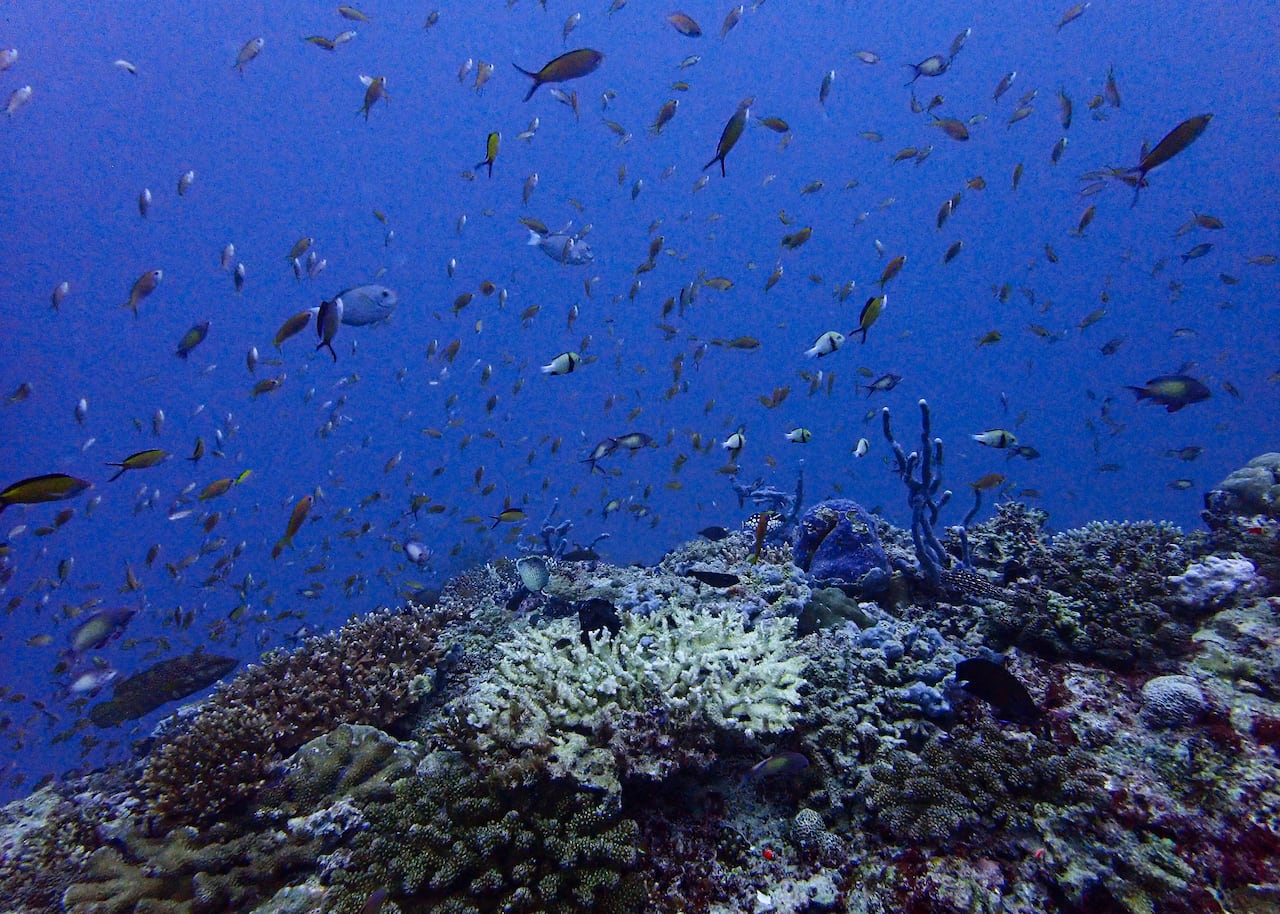
An underwater image captured in the Maldives in 2024 depicts hard corals alongside a bleached coral branch, teeming with fish. (Sarah Lai/AFP/Getty Images)
“However, as water temperatures rise, both the corals and algae experience stress. Consequently, these beneficial algae may start to emit toxins that the coral cannot tolerate, leading to a remarkable response where the coral expels the algae from its tissues.”
This expulsion leaves the corals pale, starving, and on the verge of dying, a situation referred to as coral bleaching.
“We have shown that they are not dead. Furthermore, they possess an incredible ability and potential for rapid recovery,” Collins remarked.
Only effective with genetically similar corals
Nonetheless, Collins emphasizes that the issue of coral bleaching is not resolved. The experiments have certain limitations.
For instance, direct contact is essential. When the researchers positioned the coral fragments just a few millimeters apart, no effect was observed.
“It may sound like something out of science fiction, but the healthy coral and the bleached coral actually fuse their tissues together,” he explained. “This creates a tissue bridge that acts as a nutrient highway, enabling the healthy coral to transmit nutrients and the vibrant algae to the bleached coral.”
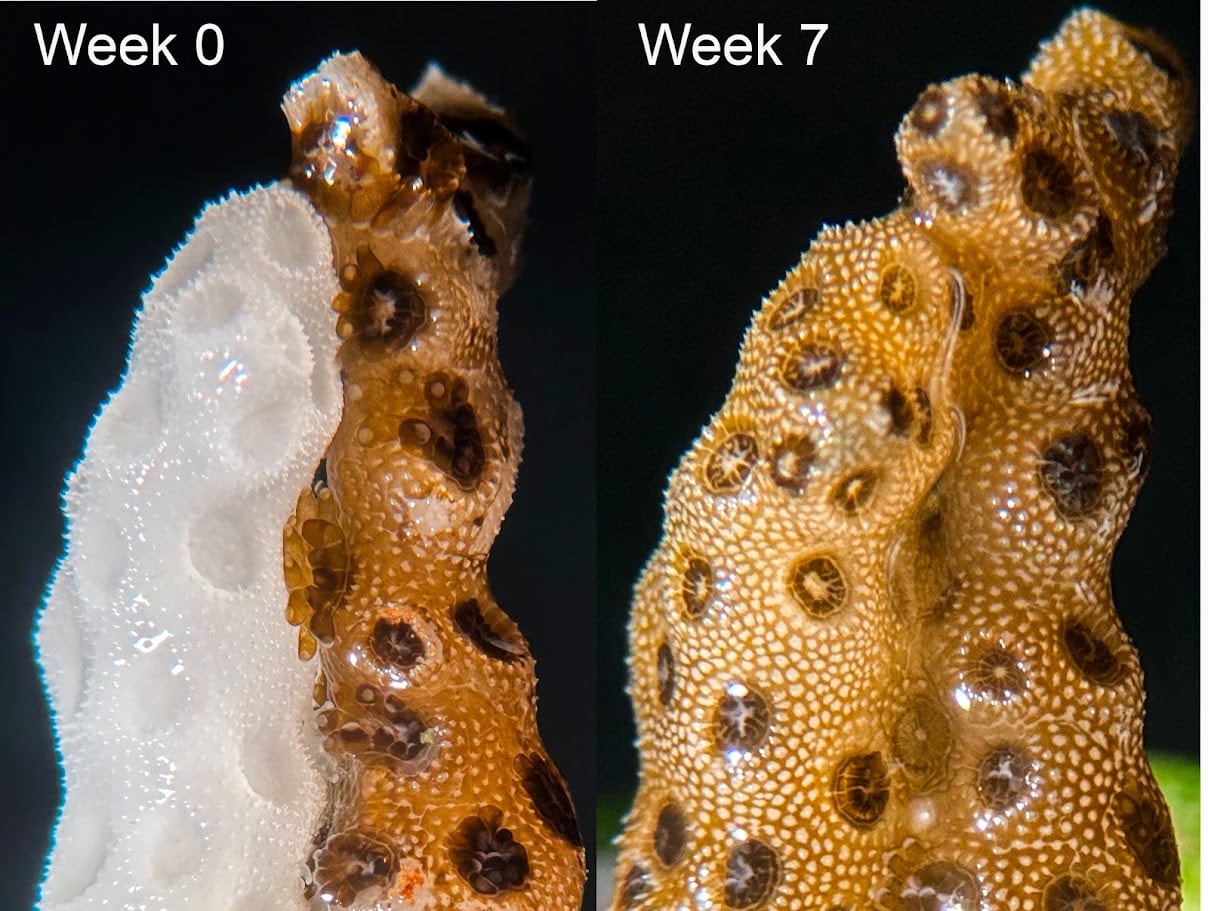
Researchers discovered that when a bleached coral touches a genetically identical healthy coral, it can recover ‘to the point where it was indistinguishable from the healthy coral,’ according to Danny Collins of Stanford University. (Dannny Collins)
Additionally, the process is only effective with genetically identical corals.
“When we placed them with corals of differing genetic backgrounds, we observed a fascinating immune and antagonistic reaction, where the corals tended to reject one another, akin to how an organ donor might be rejected in a transplant,” Collins noted.
He elucidated that this occurs because corals are “colonial animals,” comprised of thousands to millions of polyps.
“When corals of similar genetic backgrounds encounter each other, they recognize one another and can actually merge,” he added.
“Fusion is beneficial on a reef, as it allows for reconnection in case part of the coral is dislodged by a large wave.”
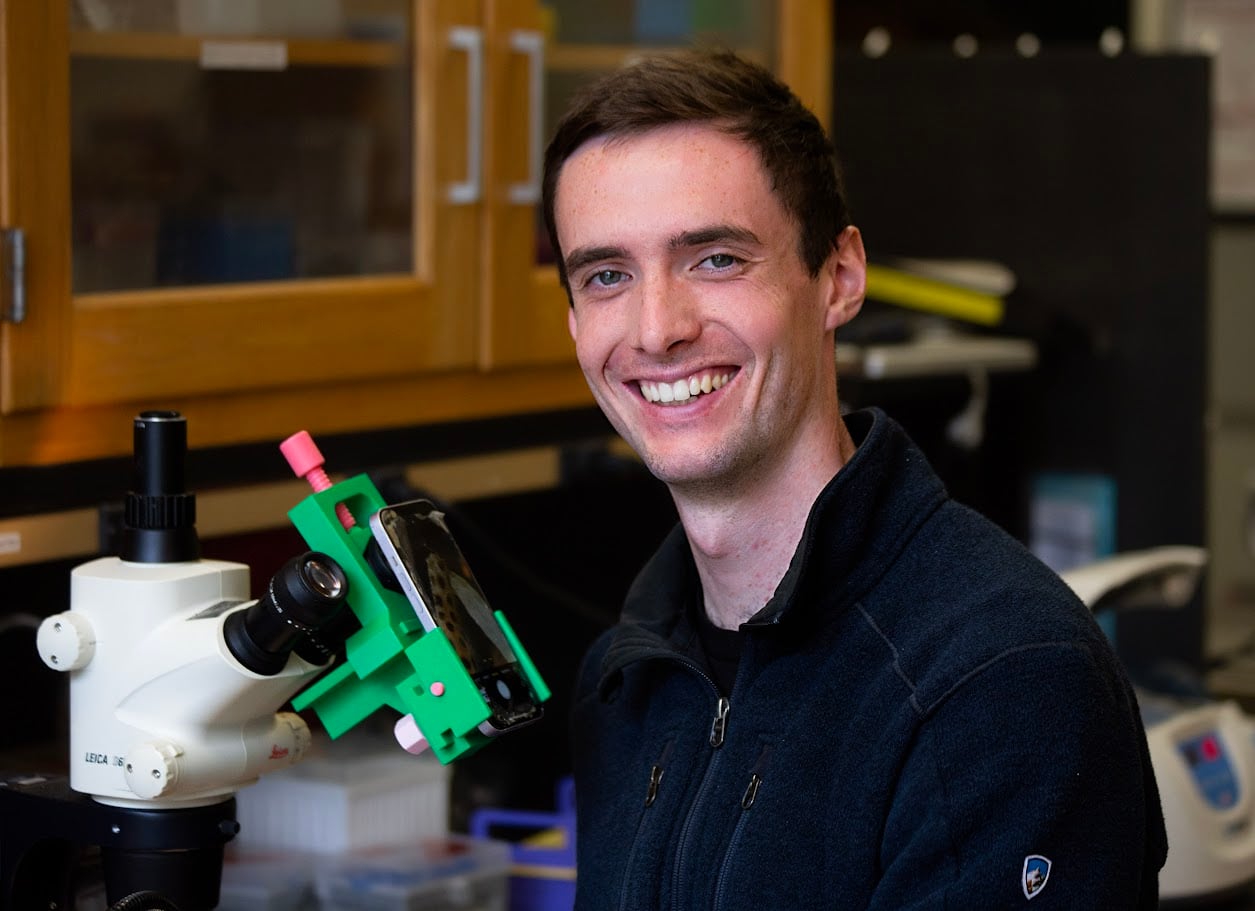
Danny Collins, an ocean scientist at Stanford University, states that his recent research offers a potential pathway for coral restoration. (Submitted by Danny Collins)
The International Union for Conservation of Nature announced that approximately 96 percent of the world’s shallow-water reef systems are critically endangered and could vanish by 2075 during a UN biodiversity conference in Albania on Thursday.
This decline is predicted to have significant repercussions for biodiversity, tourism, and fisheries, as coral reefs host between a quarter and a third of all marine species.
‘A ray of hope’
The research from Stanford serves as “a ray of hope” amid a barrage of disheartening news, according to coral scientist Julia Cole, who was not part of the study.
“I find it incredibly exciting,” remarked Cole, chair of the Department of Earth and Environmental Sciences at the University of Michigan. “The natural world can surprise us in remarkable ways sometimes.”
However, she warns that there are challenges to address.
“Considering the vastness of reefs spanning kilometers, or in the case of the largest reefs, thousands of kilometers … a method requiring coral-to-coral contact would be a meticulous and rather overwhelming endeavor.”
Collins mentioned that his team is exploring ways to extract algae from thriving reefs, cultivate it in laboratories, and utilize it to safeguard vulnerable reefs against anticipated bleaching events.
“We aspire to develop interventions that could be implemented in the field and potentially scaled in the near future,” he stated.
-
Corals in decline globally, nearly half a century of data shows
-
In good news for coral reefs, scientists identify where the toughest ones are
Even if we can rehabilitate the bleached coral, Cole emphasizes that rising ocean temperatures remain a significant threat.
“We understand how to tackle the warming climate that is causing these issues,” she asserted. “It ultimately comes down to taking serious action to reduce greenhouse gas emissions, moving away from fossil fuels, and transitioning to a clean-energy economy.”

