
According to reports from Reuters, Meta Platforms has reached an agreement with Mark Zuckerberg, influenced by a California ballot initiative that is part of the midterm elections on November 3. This measure has ignited intense discussions and attracted substantial campaign funding.
As per the agreement, Zuckerberg will receive non-voting shares that he can sell to potentially cover a multi-billion-dollar tax obligation if the proposal is approved. In return, he has committed to living in California, or wherever Meta’s headquarters is located, for a period of eight years, as stated by Meta on Wednesday.
Zuckerberg, recognized as the sixth richest individual globally by Forbes, informed Meta of his considerations to relocate his primary residence outside of California. This decision stems from concerns that Proposition 40, known as the “California wealth tax,” could result in significant tax liabilities, possibly compelling him to sell voting shares to meet these obligations.
Proposition 40 poses a question to California residents about the implementation of a one-time 5 percent tax on the state’s billionaires, requiring over 50 percent approval to succeed. California is home to approximately 250 billionaires whose total wealth exceeds $2 trillion.
The funds generated from this tax would primarily benefit state health care programs, alongside allocations for food assistance and public education initiatives.
-
Canadians caught up in Trump voter fraud crackdown as U.S. accuses Canada of election interference
-
How high inflation is hurting Trump’s Republicans in U.S. midterm campaign
Meta, the parent company of Facebook and Instagram, emphasized that Zuckerberg must continue overseeing the company from its Menlo Park headquarters during a time of “unprecedented challenges and competition within our sector.” According to Meta, it needs to secure “hundreds of billions of dollars” over the coming years to fund its AI growth strategy.
In January 2027, Meta plans to create a new category of non-voting Class C common stock. Zuckerberg, whose net worth is approximately $240 billion, will be able to sell 20 percent of the Class C shares he acquires immediately, which represents 10 percent of his total economic interest in the company, enabling him to address a potential tax obligation arising from Prop 40 while maintaining his voting rights.
Brin likens tax to Soviet-style oppression
Supporters argue that California’s initiative could raise $100 billion for healthcare, food support, and educational initiatives. However, critics estimate the revenue could be closer to $40 billion and warn that it may drive some billionaires out of the state, resulting in a loss of future tax income and investment for California.
Google co-founder Sergey Brin has invested over $100 million to defeat this ballot measure.
“I left socialism with my family in 1979 and experienced the oppressive society it created in the Soviet Union. I do not want California to follow that path,” Brin shared with the New York Times recently.

Google co-founder Sergey Brin is seen on Oct. 8 during an event at the U.S. Institute of Peace in Washington, D.C. Brin has committed millions to opposing California’s Proposition 40 ballot measure. (Julia Demaree Nikhinson/The Associated Press)
Darien Shanske, a law professor at the University of California-Davis who contributed to drafting the proposal, stated to CNBC that relocating would not mitigate the tax burden for the ultra-wealthy. Any billionaire residing in California on January 1 would still be liable for taxes under the state’s tax regulations, he noted.
Proposition 40 has the support of various figures, including California Democrat Ro Khanna in the House of Representatives and independent Senator Bernie Sanders from Vermont.
“Are we destined to live in a society controlled by a small number of the wealthiest individuals on Earth, begging for scraps?” Sanders questioned at a rally in California earlier this month.

It has been a week of challenges for the U.S. president. He terminated his newly appointed press secretary after just five days amid various staffing controversies within the White House. His approval ratings and consumer confidence have reached an all-time low. Nevertheless, he continues to travel across the country and criticize Canada while rallying Republican voters. With only two weeks remaining until the midterm elections, guest correspondent Peter Armstrong joins Washington correspondents Katie Simpson and Willy Lowry to analyze the potential repercussions of Trump’s recent difficulties.
Approval of the measure uncertain
The initiative has not neatly divided progressives and Democrats in favor against billionaires opposed.
For instance, Jensen Huang, CEO and co-founder of Nvidia, has dismissed the proposal.
“The ability to pay $8 billion in taxes over five years is a privilege,” Huang stated to CBS News earlier this week. “I view it as a privilege and a responsibility. Nothing would bring me greater joy than to be able to contribute even more in taxes.”
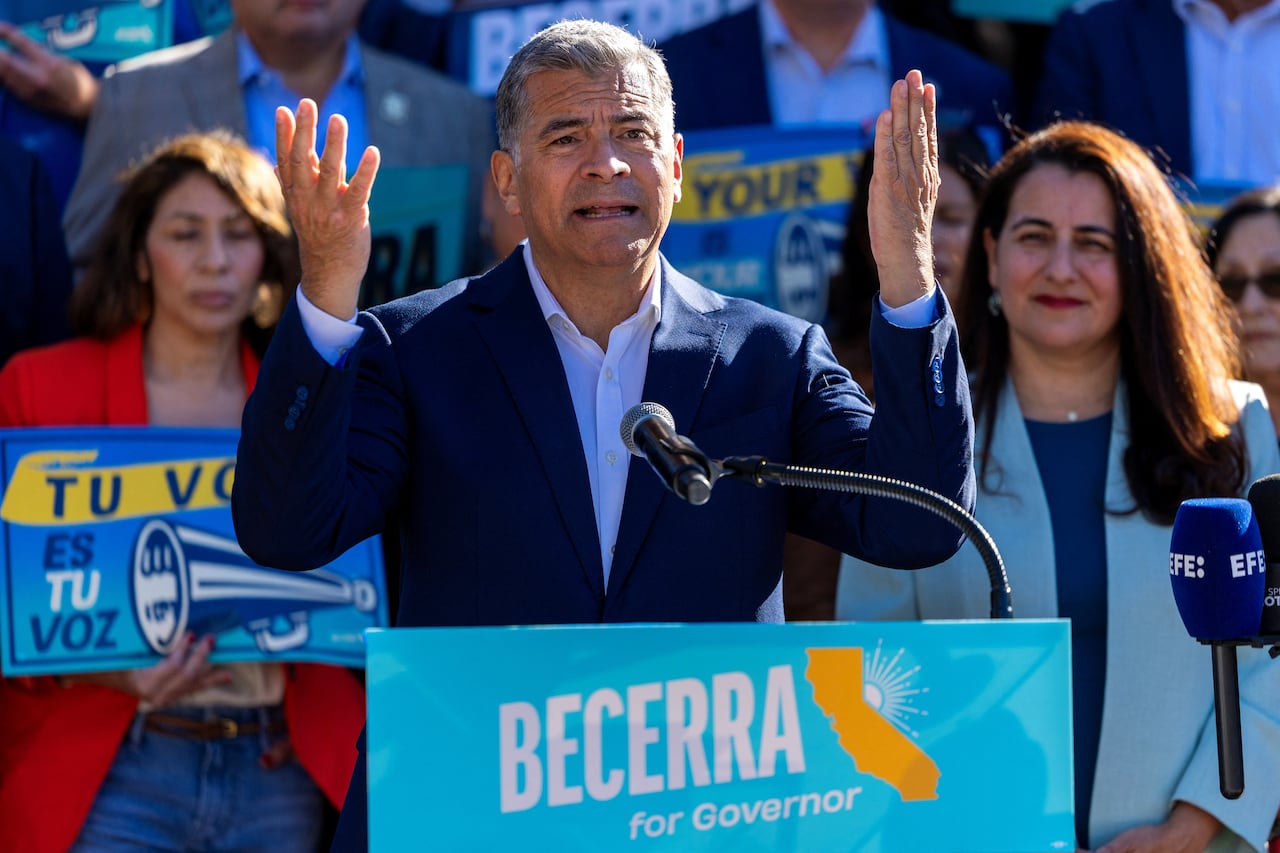
Democratic gubernatorial candidate Xavier Becerra, seen at a Los Angeles campaign stop on Oct. 15, believes Proposition 40 does not adequately address funding for state services. (Mike Blake/Reuters)
At the same time, outgoing Democratic Governor Gavin Newsom has voiced his opposition to Proposition 40, supporting the Brin-backed Proposition 42, which aims to amend the state constitution to prohibit such tax initiatives after January 1, 2026.
Newsom’s stance received criticism from actor Mark Ruffalo, who described it as “beyond sad” on social media. Addressing Newsom directly, Ruffalo asserted that Democrats require someone who is “resilient in confronting the real disparities that people face daily: billionaires versus the people and the planet.”
However, current Democratic gubernatorial candidate Xavier Becerra and the California Teachers Association (CTA) also stand against the measure, contending that while it is well-meaning, it represents a complex and unsustainable funding approach. The CTA is concentrating on Proposition 3, which proposes to raise funds through an increase in state income tax for high earners.
Becerra’s Republican challenger, Steve Hilton, is firmly against Proposition 40.
Historically, California voters have only approved about one-third of citizen initiatives. Additionally, political analysts note that ballot measures in California typically require strong initial backing, as undecided voters often lean towards a no vote as the election date approaches.
“California ballot initiatives usually lose traction over time, and if the polling is below 50 percent in August, it signals a poor outlook for its chances,” remarked John Pitney, a politics professor at Claremont McKenna College, in a report published by Reuters on September 30.
A Citrin-Politico survey released this week revealed that among those expressing a viewpoint, 46 percent supported Proposition 40 while 43 percent opposed it.
Tag: rewrite-pending

