
Ontario Premier Doug Ford unveiled the province’s new data centre framework on Thursday, emphasizing that it will “ensure Canadians’ data remains in Canada.”
The framework for approving data centres is grounded in three main areas: economic development, data protection and sovereignty, as well as community investment and public trust.
“With our new data centre playbook, our government aims to foster the economy of the future, which will generate billions in economic growth, boost tax revenues, and create thousands of new jobs, all while ensuring data centres operate under the appropriate rate rules,” Ford stated during the announcement in Guelph.
“Our framework mandates that data centres must bear the full costs of their electricity consumption, which incentivizes them to establish their own power generation and creates a distinct rate class for large new data centres with rates that exceed existing industrial programs for major electricity users. No costs will be transferred to the hardworking families of Ontario.”
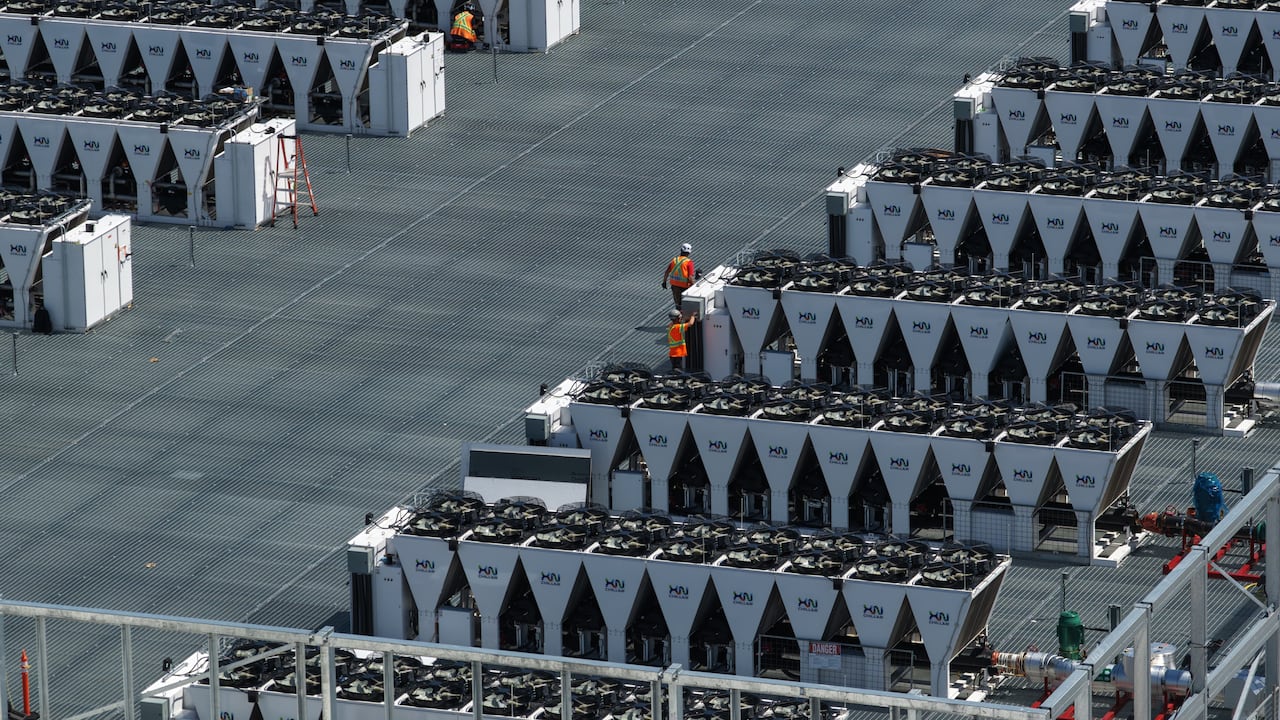
An aerial view of the construction of the TOR1X0 Data Centre at SteelesTech Campus in Toronto. The Ontario government has introduced a new “playbook” that data centres must adhere to. (Patrick Morrell/CBC)
Ford also mentioned that the province “will not provide financial incentives to attract investments.”
The government stated that its framework will act as a “key enabler” for its artificial intelligence (AI) strategy, which is projected to yield economic advantages, including $122 billion in growth by 2035 and the creation of 17,000 new jobs each year.
This announcement occurs as municipalities throughout the province are considering moratoriums on data centres, with Oakville voting to impose a one-year moratorium on Tuesday and Mississauga set to vote on its own moratorium in September.
-
Toronto’s request for provincewide data centre framework not enough, moratorium needed, some residents say
-
Building cleaner AI data centres better than not building at all, CEO behind Hamilton proposal says
Playbook ‘falls short’: Ontario Greens
Last week, Green Party of Ontario leader Mike Schreiner called for a halt on data centres, expressing concerns that corporations are the primary beneficiaries of local water resources rather than Ontario communities.
Ilham Abdulkadir of Wellington Water Watchers supported Schreiner’s call, highlighting that the infrastructure needed for these data centres is “largely physical,” necessitating land use, energy consumption, and a significant demand for water.
In Toronto, over 5,000 residents have signed petitions expressing their concerns regarding data centres in their neighborhoods.
Vic Fedeli, Ontario’s economic development minister, remarked that the province will “ensure priority is given to data centres that utilize a closed loop system.”
A closed loop system functions similarly to a car radiator, reusing water to minimize water usage.
Ford echoed this sentiment, stating that his government will “prioritize constructions featuring closed loop systems that use virtually no water during operations.”
“I think the public needs to understand much more about data centres,” the premier remarked. “It’s ironic when a municipality claims, ‘I don’t want a data centre, but all my businesses require one. They need AI. My hospital needs AI, and everyone in that community uses social media and computers.’ It doesn’t make sense.”

Green Party of Ontario Leader Mike Schreiner is urging the province to pause approvals for new AI data centres. (Evan Mitsui/CBC)
However, Schreiner believes the playbook “falls short.”
“The premier employed a lot of vague and reassuring language. They provided no details or specifics, nor any strong regulations such as prohibiting the construction of a data centre in Ontario unless it employs a closed loop water system,” Schreiner told CBC News.
“So until such protections are enacted… Ontario Greens are advocating against new data centres.”
Schreiner acknowledged the significance of data protection and sovereignty and recognized that data centres will “be part of our future.”
“But we want to ensure that communities and individuals maintain control, not tech billionaires and fossil gas corporations,” he added.
“[The Ontario Greens will] persist in advocating for a moratorium until robust regulations are established to safeguard people and communities from data centres.”
-
Video
New $40M federal investment will strengthen tech businesses in Waterloo region
-
Video
‘Hundreds and hundreds of jobs’: Minister announces $40M investment into Waterloo region and Brant businesses
Waterloo region assessing local impacts
This week, Coun. Colleen James submitted a motion requesting staff to prepare an information report for the Region of Waterloo council, aimed at educating elected officials about the development of data centres, along with their economic and environmental effects.
James noted that the proliferation of data centres is “not going away” and emphasized the need for further understanding.
Wilmot Mayor Natasha Salonen expressed concerns regarding the staffing resources needed to compile a report of this nature, but CAO Darshpreet Bhatti assured that staff are already “working on a plan that would encompass many of the requests being made.”
“It’s not merely about funding. It’s about community. Community safeguards, frameworks, and what is currently in place,” James stated.
The report is anticipated to be completed early next year.

