
This summer, Europe experienced unprecedented heat, leading to the deaths of over 50,000 individuals, with nearly 66% of this figure attributed to climate change driven by human activities, according to a new study.
In their research, scientists analyzed heat-related fatalities across various age demographics in 854 cities throughout Europe during a series of heat waves in June, July, and August. They determined that 50,391 people perished due to elevated temperatures, and among these, 32,619 deaths were linked to the additional heat generated by the combustion of fossil fuels such as coal, oil, and gas, as noted in a forthcoming edition of Nature Health.
This figure marks a 71% increase compared to the previous record summer death toll of 29,480 in 2022, as reported by the same research team, which had earlier focused on tracking annual summer heat-related deaths in these European cities. The current summer’s death estimates are likely low, as they do not include a deadly heat wave in May and only account for fatalities in the 854 cities that together represent around 40% of Europe’s population, according to the study authors.
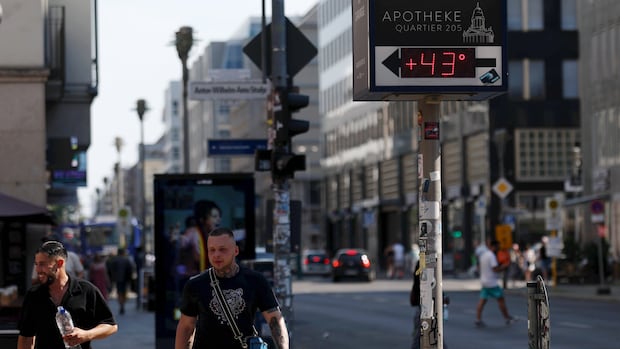
Much of western Europe saw another scorching day on Saturday amid a deadly heat wave that has already broken temperature records in Britain, France and Spain. The heat is moving east across the continent, with one expert warning Switzerland’s glaciers are set to lose a massive amount of ice due to the heat wave.
Approximately one-third of the heat-related deaths occurred between June 17 and July 1, during an especially severe heat wave that saw temperatures rise 5.3 degrees Celsius above the norm, according to Garyfallos Konstantinoudis, a biostatistician at Imperial College London and co-author of the study.
“In much of Western and Northern Europe, our infrastructure is not equipped to handle the extreme temperatures we are currently experiencing as a result of human-induced warming,” stated Clair Barnes, lead author and climate scientist at Imperial College London. She noted that some European cities recorded temperatures 12 degrees Celsius above average this summer.
From the total of 50,000 deaths, over 32,000 were attributed to the additional heat produced by human-induced climate change, the study revealed. The highest death rates were observed in Italy, France, Spain, and Germany. Additionally, among all European capitals, Rome recorded the highest total of heat-related fatalities from 2000 to 2025, according to the team’s earlier research.
An extra dose of heat from fossil fuel burning
Barnes explained that this would have already constituted an unusual natural heat wave exacerbated by significant climate change. She pointed out that while Europe is the continent experiencing the fastest warming — with the Arctic warming even more rapidly — it is currently 2.5 degrees Celsius hotter than it was before the industrial era.
“The underlying warming caused by human activities, primarily through fossil fuel combustion, is raising our temperatures by what might seem like a minor amount,” Barnes remarked. “For many individuals, that additional 2.5 degrees Celsius increase is sufficient to shift conditions from uncomfortable to perilous and potentially fatal.”
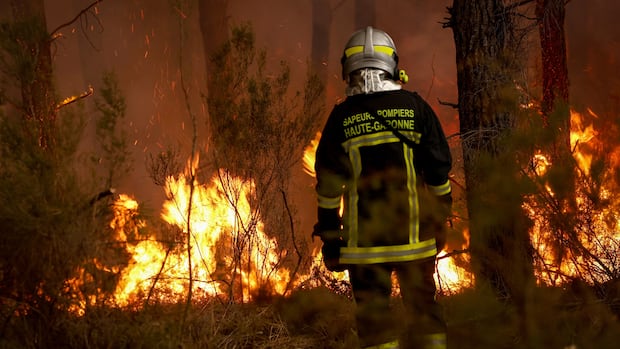
Rapidly spreading and deadly wildfires in France and Spain have forced more than 300,000 people to evacuate, and there is concern that a looming heat wave could make the situation worse.
Over half of the fatalities due to the heat wave involved individuals aged 85 or older, but more than 800 victims were between the ages of 20 and 44, according to Konstantinoudis.
How the death numbers are calculated
The research team employed a well-established scientific approach to determine how many of the 50,000 heat-related deaths were due to naturally high summer temperatures versus those caused by the impact of heat-trapping emissions on the climate. They conducted computer simulations of a world without climate change and compared these to the actual death toll from this summer. The discrepancy was attributed to global warming.
The proportion of heat-related deaths linked to global warming has increased from approximately 45% in the early 2000s to 65% today, as stated by Barnes.
“Summers are becoming hotter, and the tools used to analyze heat-related fatalities are improving in accuracy,” remarked Dr. Howard Frumkin, a former director at the National Center for Environmental Health in the U.S., who was not involved in the study. “These two trends result in increasingly precise counts of heat-related deaths.”

The record global heat brought by this year’s powerful El Niño could lead to nearly half a million more deaths worldwide by the end of February, according to a report that also highlights the impact of climate change on extreme heat.
To arrive at the estimated 50,000 heat-related deaths, the scientific team utilized statistical modeling, as these fatalities are often underreported and typically omitted from death certificates despite being a significant contributing factor, noted Konstantinoudis. Several external experts concurred with his assessment, describing the methods as cutting-edge.
The researchers implemented a sophisticated mathematical model used in various previous peer-reviewed studies, as explained by Barnes. This model accounts for specific age demographics and temperature data for each of the 854 cities, based on a localized optimal temperature associated with the lowest mortality rates. The equation calculates excess deaths when temperatures are above or below this optimal range.
The team then validated their calculations by comparing them with real-time estimates from governmental sources. In most instances, the figures aligned reasonably well, as stated by Konstantinoudis. For example, their calculations for excess deaths during the May and June heat waves in Britain estimated 2,700 fatalities, which closely matched the 2,800 reported by the UK’s health statistics agency.
Cooling and adapting are needed, but they’re not enough
“We must prepare for the heat we cannot currently avoid, which requires urgent investments in heat early-warning systems, equitable access to low-carbon cooling solutions, and community support systems to assist those most at risk — all while significantly reducing the fossil fuel consumption that is exacerbating the crisis,” emphasized Dr. Courtney Howard, a Canadian emergency room physician and president-elect of the Canadian Medical Association, who was not part of the study.

CBC’s senior health and medical reporter Lauren Pelley ran for 20 minutes in a heat chamber set at 40 C while researchers measured the strain that the heat put on her heart, weight and core and skin temperatures. This is what the results showed.
Dr. Jonathan Patz from the University of Wisconsin-Madison, who was not involved in the research but praised it, stated that adaptation is just one aspect of the solution.
“We cannot merely clean up the aftermath without addressing the root cause,” Patz remarked, emphasizing the need for prevention at multiple levels. “We require improved cooling methods and protection for vulnerable populations against the increasing frequency and severity of heat waves. However, we also need to confront the fundamental issue of fossil fuel combustion.”

