
On Tuesday, a Japanese spacecraft launched towards Mars on a groundbreaking mission aimed at investigating its enigmatic moons and returning samples.
For this five-year endeavor, five global space agencies collaborated to land a robotic explorer as well as a rover on Phobos, which is the larger and nearer of Mars’s two small moons.
The Japan Aerospace Exploration Agency, spearheading this ambitious sampling initiative, lifted off the spacecraft shortly before dawn from Tanegashima Island, Japan’s primary spaceport. An hour later, officials celebrated the success of the mission as the spacecraft detached from the rocket’s upper stage as planned. Flight controllers erupted in applause, standing up to shake hands and embrace one another.
While NASA has successfully landed nine spacecraft on Mars over the last half-century and China achieved a successful landing in 2021, no one has previously set foot on Phobos or its companion Deimos. Furthermore, no one has retrieved samples from Mars or its moons.
If all goes well, samples of dust, soil, and rocks from Phobos are expected to arrive on Earth by 2031.
“There’s a lot of adrenaline, excitement, and a sense of awe,” remarked NASA astrophysicist Tom Statler, who is part of the project.
Japan has an advantage, having already completed two successful asteroid sample return missions.

Employees of the Japan Aerospace Exploration Agency and others celebrate at the Tanegashima Space Centre after the successful separation of a Japanese spacecraft from an H3 rocket on Tuesday. (Naoki Hiraoka/Kyodo News/The Associated Press)
Phobos: A peculiar, small moon
Phobos is an irregularly shaped, potato-like body measuring approximately 22 kilometers across. Analyzing its materials could shed light on the origins of Mars’s moons and potentially those of other celestial bodies.
Named MMX for Martian Moons Exploration, the mission, which costs $812 million ($578 million in US dollars), includes a substantial five-ton spacecraft expected to reach Mars by late next summer. It will align with Phobos’s rapid orbit around the planet before releasing the French-German rover named Idefix, inspired by the white terrier from the Asterix comics.
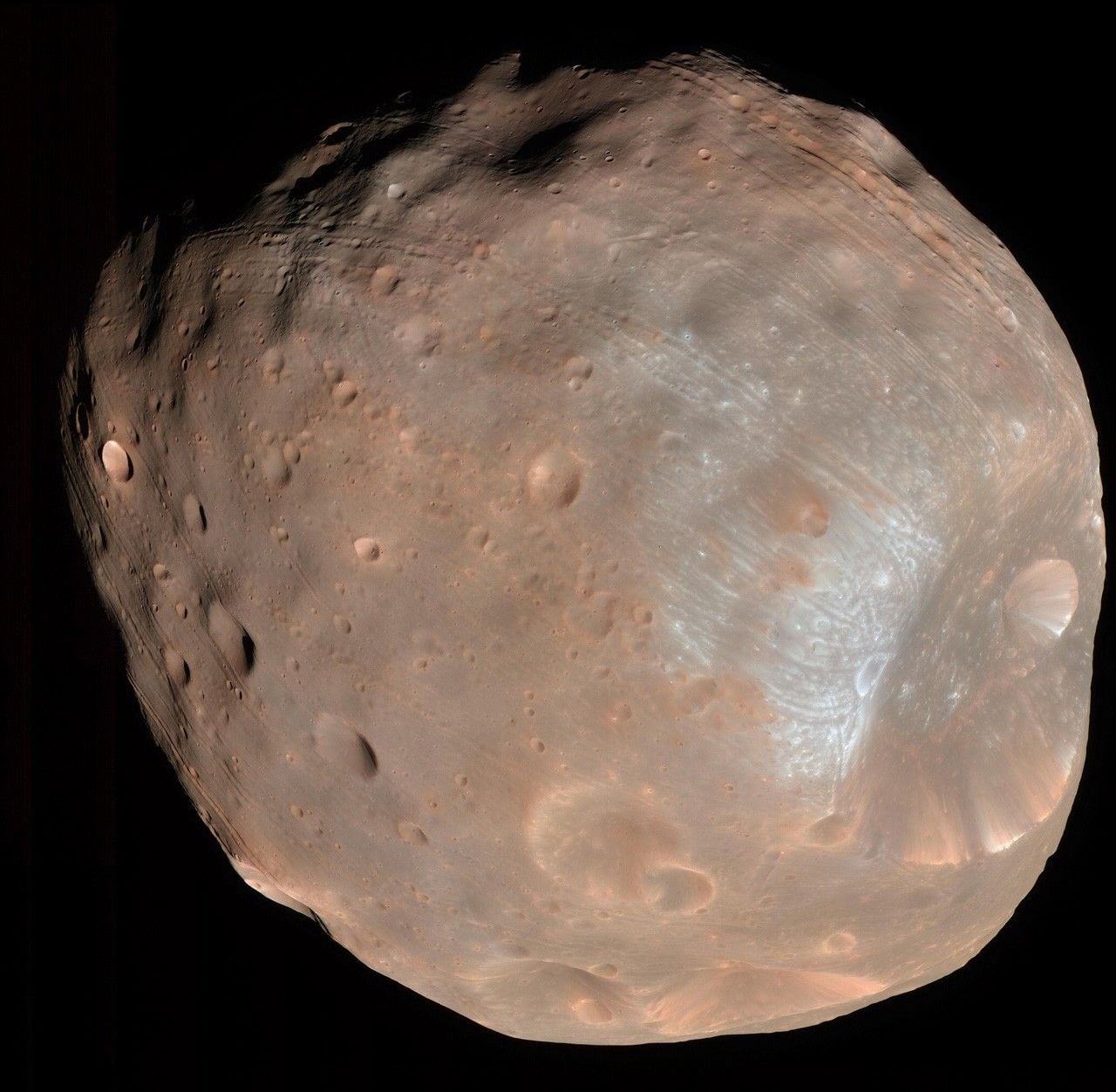
This image, captured by NASA’s Mars Reconnaissance Orbiter on March 23, 2008, shows Phobos, one of Mars’s moons. No spacecraft has previously visited there. (NASA/The Associated Press)
Idefix, which is about the size of a microwave oven, will land on Phobos autonomously, bouncing for several minutes before finally resting due to the moon’s incredibly low gravity.
Post-landing activities of the Idefix rover
This four-wheeled rover is engineered to right itself if it ends up upside down. However, if it sinks into loose soil or becomes trapped between rocks, its fate is uncertain, warned Julien Baroukh from the French Space Agency. Once Idefix deploys its solar panels, it will no longer be able to right itself, leading to a deliberate movement speed of just one millimeter per second (0.04 inches per second).
Baroukh described Idefix as a “safety scout,” as it will explore Phobos for 100 days. Japanese flight controllers aim to bypass loose soil and challenging terrain as the main lander—a four-legged stationary unit—prepares to descend to collect samples in late 2028 or 2029.
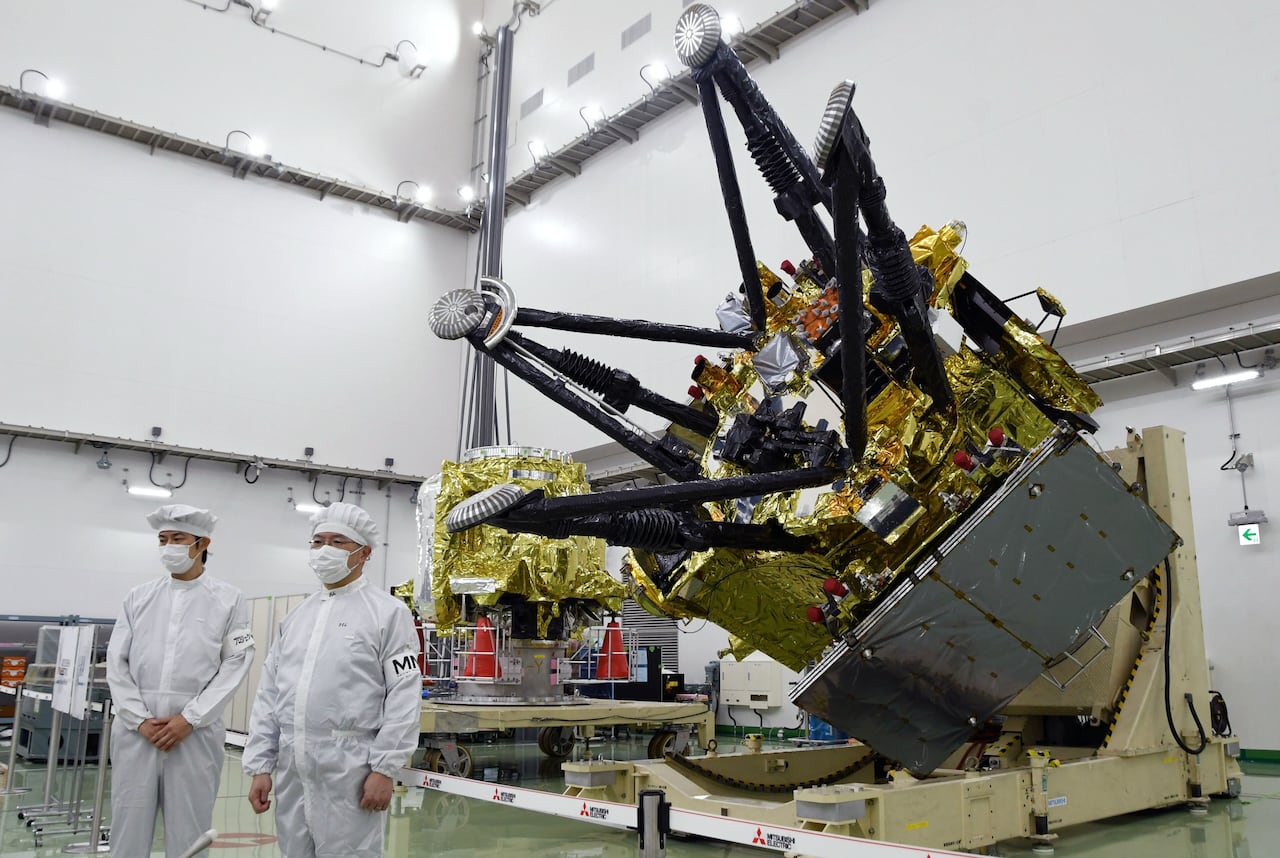
The Japan Aerospace Exploration Agency reveals a spacecraft for its Martian Moons eXploration mission at the Tanegashima Space Center in Minamitane, Japan, on August 13, 2026. (Yuika Kawazoe/Kyodo News/The Associated Press)
The lander will have a brief two-hour window on Phobos to drill and vacuum at least 10 grams (one-third of an ounce) of material before it launches back into space. It will subsequently conduct flybys of Deimos before departing the Martian vicinity in 2030 and making its way back to Earth for a sample landing in the Australian desert in 2031.
This mission poses significant challenges, with debris scattered along the route.
The names of the moons offer little reassurance: Phobos translates to fear in Greek, while Deimos means dread. They are the twin sons of Ares, the god of war (known as Mars in Roman mythology).
Researchers aim to uncover the formation of Mars’s moons
Russia faced failures in all three attempts to reach Phobos and numerous other Mars missions. Japan also struggled in its prior Mars mission, failing to place a spacecraft into Martian orbit. Even NASA has encountered setbacks in its quest to resolve the critical question: Did life ever exist on Mars?
By examining Mars’s moons, scientists hope to determine if Phobos and Deimos originated from a historic collision involving Mars and a large space object. Alternatively, these moons might be rogue asteroids that were captured by Mars’s gravitational pull.
Regardless, scientists expect to discover remnants of Mars on Phobos, making the samples an enticing dual opportunity that could enhance our understanding of planetary and moon formation, and possibly the origins of life.
The insights gained will inform future Mars missions, including those involving astronauts, stated Lindsay Hays, NASA’s acting planetary science director.
“This is a once-in-a-lifetime opportunity. We are part of the inaugural sample return mission from the Martian system,” remarked Markus Grebenstein, rover chief at the German Space Agency.
Japan is not the only nation aiming to harness the scientific wealth contained in the rocks and soil of the Martian system. China intends to launch its own sample return mission to Mars in 2028, while NASA continues to deliberate on how to retrieve over 30 sample tubes gathered by the Perseverance Mars rover, now renowned for its off-Earth driving.
Japan and China could be in close competition to bring back samples from the Martian system, with both targeting 2031.
Japan is committing $350 million to this mission, while NASA is contributing $122 million ($87 million US), the French Space Agency approximately $95 million ($68 million US), the German Space Agency around $79 million ($56 million US), and the European Space Agency about $24 million ($17 million US).
Tag: rewrite-pending

