
EverWind Fuels, a company focused on green hydrogen, must provide additional details to the province before it can advance with its planned wind farm in Guysborough County.
On Thursday, Nova Scotia Environment Minister Tim Halman announced his decision regarding the environmental assessment of the Harbour Hills Wind Project. He noted that the company had not completed the necessary baseline field surveys for approximately 6,000 hectares that would house 30 wind turbines.
The required surveys, which must be finished within a year, need to include assessments of moose, bats, birds, turtles, plants, and lichen, according to the minister.
Claire Parsons, a spokesperson for the company, stated that EverWind is currently evaluating the minister’s decision.
“Our intentions for Harbour Hills remain unchanged, and we are dedicated to pushing the project forward while collaborating with Nova Scotia Environment and Climate Change to furnish the requested additional information and proceed with the environmental assessment,” she said.
The Harbour Hills initiative, which includes 107 turbines, is one of three large wind farms that EverWind has proposed for Guysborough County. Additionally, the company is developing four smaller projects in various regions of the province.
EverWind ultimately aims to harness wind energy to power a facility for the production of green hydrogen and ammonia located in Point Tupper, N.S.
Potential buyer lost
The company plans to export its ammonia product across the Atlantic. In 2022, EverWind announced that it had two prospective buyers in Germany, both of whom had signed memorandums of understanding to purchase up to 500,000 tonnes of ammonia per year.
However, as reported by the Halifax Examiner, EverWind has now lost one of those potential customers.
E.ON Group, a global electric utility firm based in Germany, stated that it “deprioritized” all hydrogen-related endeavors last year.
“Current developments in the green gas market in Germany suggest a significantly slower growth rate than anticipated, and the overall scope or speed of this growth remains difficult to predict,” a representative from the company mentioned in an email.
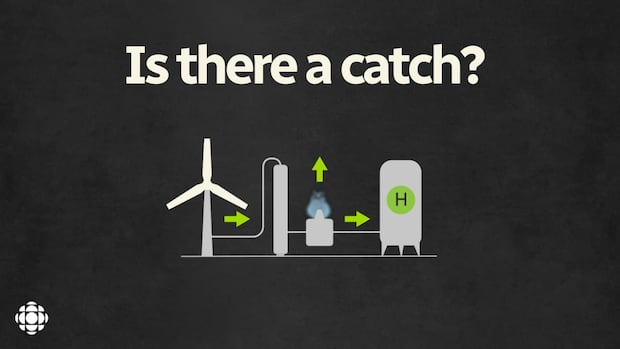
Green hydrogen has been labelled as one solution for Canada to meet its net zero goal by 2050. CBC’s Frances Willick finds out if green hydrogen is really better for the environment.
Parsons noted that the changes at E.ON do not affect EverWind’s plans, as it was merely “one of many potential European customers.”
“The demand for clean fuels is increasing, and we are confident in the market for our product as well as our ability to secure the necessary offtake for the initial phase of the project,” she emphasized.
Parsons also mentioned that EverWind continues to engage with Uniper—the other German company that signed a non-binding agreement four years ago—along with other unnamed European partners, although she did not disclose how many.
Bear Head Energy stops providing updates
In a related development, another firm aiming to produce green hydrogen in Nova Scotia has gone silent.
Around the same time as EverWind, Bear Head Energy proposed the establishment of a green hydrogen and ammonia production facility in Point Tupper, N.S., utilizing wind energy.
The company received environmental approval for its primary facility in 2023. A stipulation of this approval was that construction must commence within two years. Although construction has not yet begun, the Environment Department confirmed that it has granted an extension until 2027.
-
Nova Scotia outlines plan to support green hydrogen industry
-
Province approves second green hydrogen proposal for Point Tupper
Bear Head has not sought environmental approval for any wind farms and has not made any recent public announcements.
In response to inquiries from CBC News, Buckeye Partners, the Texas-based parent company of Bear Head, stated that its subsidiary is “not providing project updates at this time.”
Hydrogen market still moving forward, prof says
David Layzell, a professor emeritus at the University of Calgary who specializes in green energy systems, indicated that green hydrogen is essential for global decarbonization.
“There aren’t many energy systems that will not contribute to significant climate change globally,” he remarked during an interview.
However, he acknowledged that the hydrogen sector has progressed more slowly than initially expected.
“We’ve experienced notable geopolitical changes…and there are other priorities, even within Canada, that have risen to the forefront,” Layzell noted.
Despite this, he believes that green hydrogen production in Nova Scotia is feasible; it will simply take longer to materialize.
MORE TOP STORIES
-
Halifax Water portal remains offline months after privacy incident
-
Volunteer-run Port Hastings museum trying to fill void after visitor centre closure
-
Babies and toddlers are sweltering in some daycares. Should there be mandatory AC?
-
Beautiful but vicious: invasive roses a menace to N.S. ecosystems
-
Bail hearing for Halifax man charged in U.S. consulate bomb threat case delayed again
Tag: rewrite-pending

